Case study · 2-minute summary
Ordering cancer treatment before the start date is known
Oncology teams usually don't know when treatment will start at the moment they order it. The system demanded a date anyway, so everyone made one up. I redesigned how a start date is set, tracked and changed.
- Role
- Team Lead, UX design and research
- Timeline
- Aug – Nov 2026
- Platform
- Enterprise EHR, oncology ordering
- Status
- Direction validated, in development
In short
A required calendar date at ordering, when the real date is unknown 50–80% of the time.
The empty date field wasn't the real pain. The system hid the whole signed plan from nurses and pharmacy until a date existed.
Separate “signed” from “dated”. Capture intent (a date, a timeframe, or TBD with reasons), let anyone on the team clear blockers, and make date changes visible to everyone.
The problem
One required date, and nobody knew it yet
A regimen's start date is Day 1, the first dose. Pharmacy prep, infusion chair bookings, insurance approval and patient safety checks all hang off it. But at the moment a provider orders treatment, that date usually depends on things that haven't happened yet. The legacy flow had one mandatory date picker, so people guessed.
| Day | Medication | Dose | Route | Freq | Admin Date | Status |
|---|---|---|---|---|---|---|
| D1 | CENDRAVINE | 57.3 MG | IV | ONCE | 12/01/26 2 | PEND |
| D1 | ETORVEX | 229 MG | IV | ONCE | 12/01/26 | PEND |
| D2 | ETORVEX | 229 MG | IV | ONCE | 12/02/26 | PEND |
| D3 | ETORVEX | 229 MG | IV | ONCE | 12/03/26 | PEND |
| D1-3 | DEXAMORYL | 8 MG | IV | DAILY | 12/01/26 | PEND |
- One mandatory date. There was no way to say “not yet”, or why.
- So teams typed a placeholder date, and every downstream date inherited the guess.
- The real status lived in free text, side spreadsheets, sticky notes and messages, outside the chart.
It's wishful thinking.
Research
What six oncology sites told me
Mixed-methods discovery: a landscape and constraints review, a stakeholder session, a survey of 6 customer sites, and moderated prototype reviews at three: a small US community program (Site A), a US regional hospital (Site B) and a UK public hospital (Site C). I synthesized it into 10 findings, each mapped to a design implication.
Not knowing is the norm
Sites entered a real date at ordering half the time or less. One estimated 80/20.
Many things hold up a start
Prior authorization at every site, infusion chairs at 4, labs at 3, often several at once.
Everyone guesses, then fixes by hand
Placeholder dates everywhere, with the real status kept outside the chart.
The real pain is visibility
“Dates change and the changes aren't visible to everyone who needs them” ranked top.
Ownership differs by site
Schedulers, providers, nurses or pharmacists own the date, depending on the site.
Honest note: a small sample (6 survey sites, 3 sessions), and schedulers weren't interviewed yet.
The problem isn't the empty date field. It's that the system hides the plan.
Design principles
- Signing and dating are separate steps.
- Capture intent, not just absence.
- Blockers are visible, advisory, and clearable by others.
- Date status and changes are obvious to everyone.
- Moves follow how treatment actually happens.
- Don't make people enter information they don't have yet.
The design
Sign the plan now. Date it when you know.
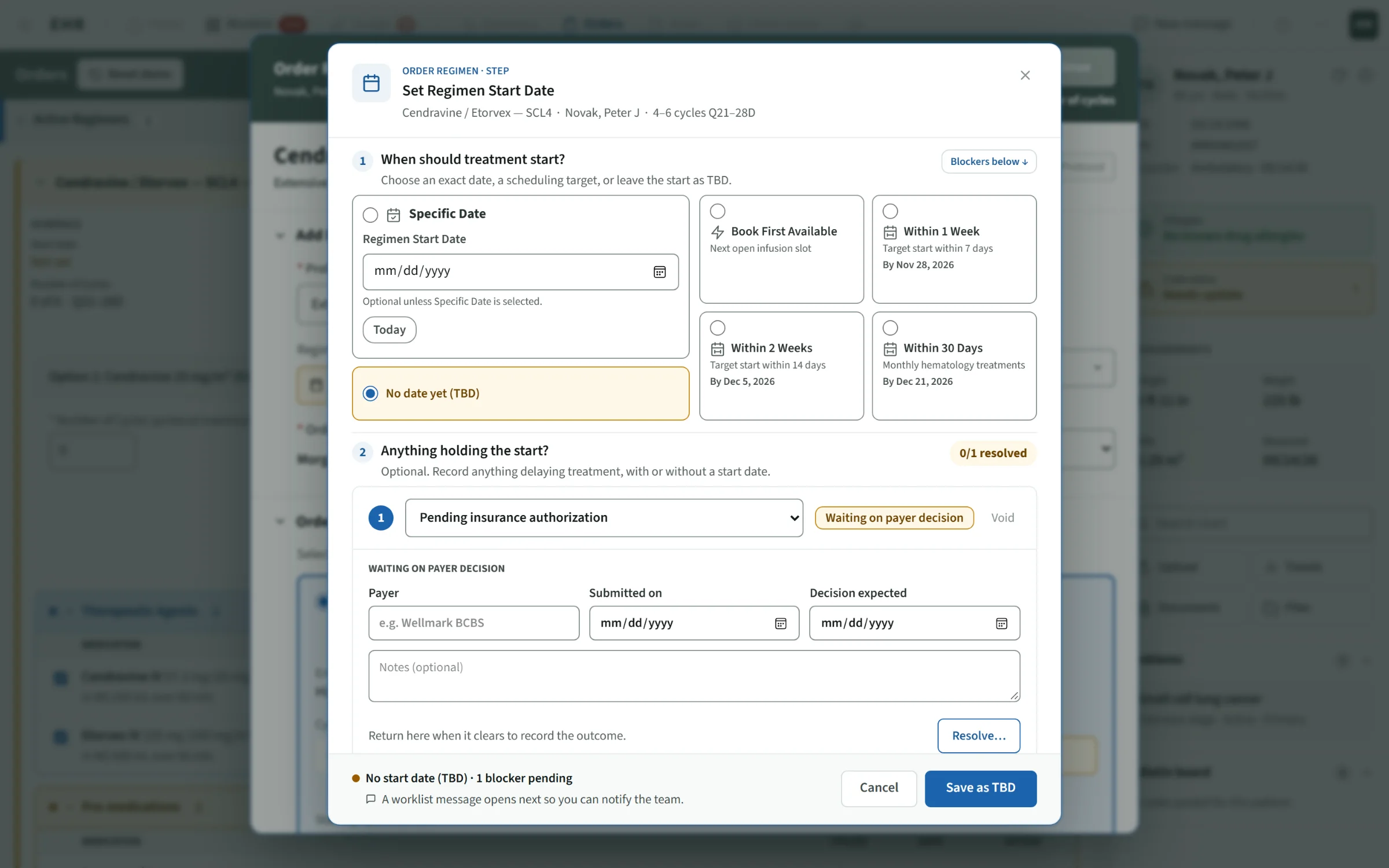
- A start date step with real choices. An exact date (with Today as a shortcut), one-click scheduling targets that show the actual dates in each window, or “No date yet”.
- Blockers instead of guesses. TBD plus up to three structured reasons from the site's own list. A provisional date is still allowed while a blocker is open.
- Closed-loop messages. Saving a blocker or a scheduling target drafts a worklist message to the people who can act on it, editable before sending.
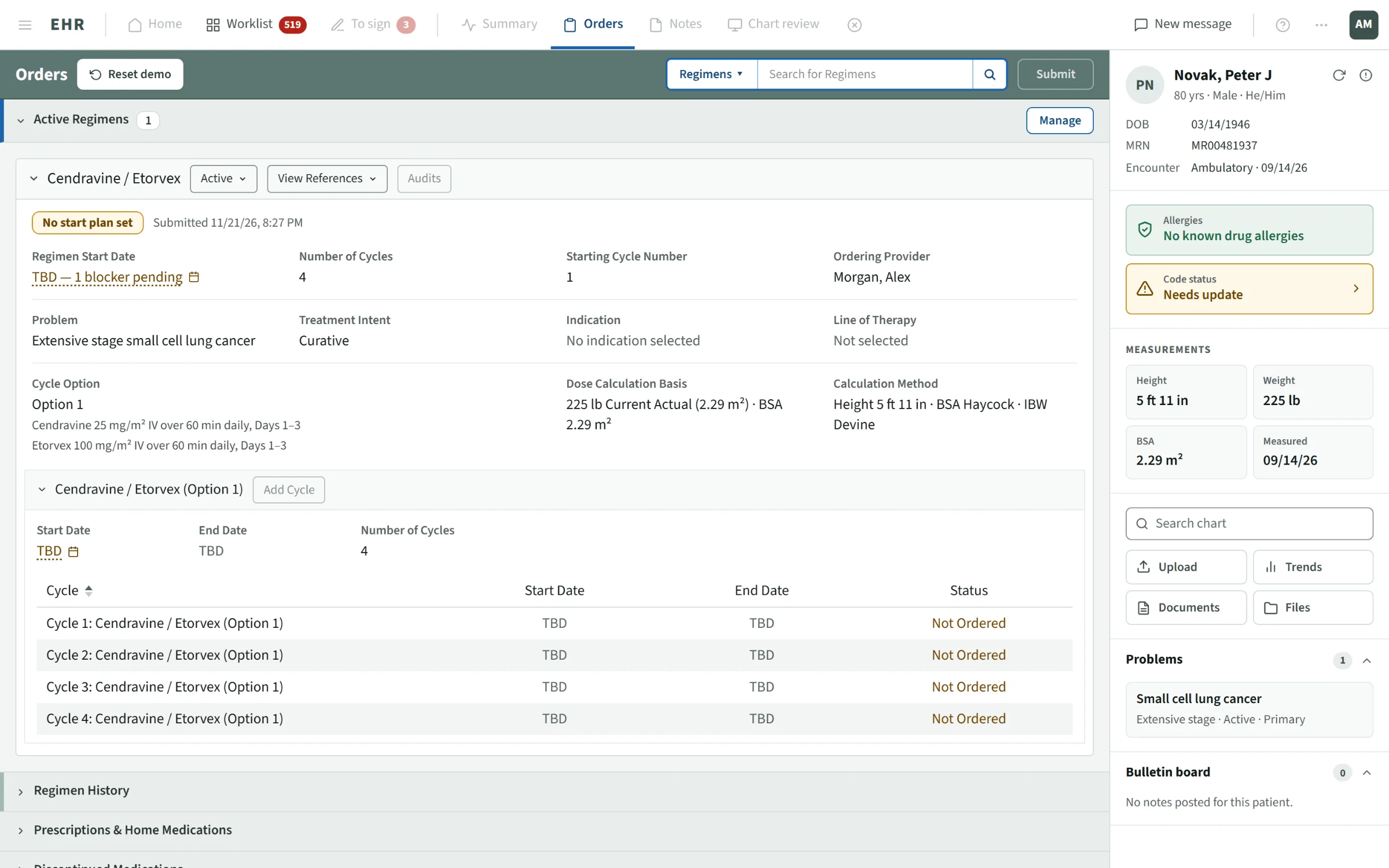
- Visible the moment it's signed. The order shows its date status and what it's waiting on, everywhere it appears. Anyone on the care team can resolve a blocker.
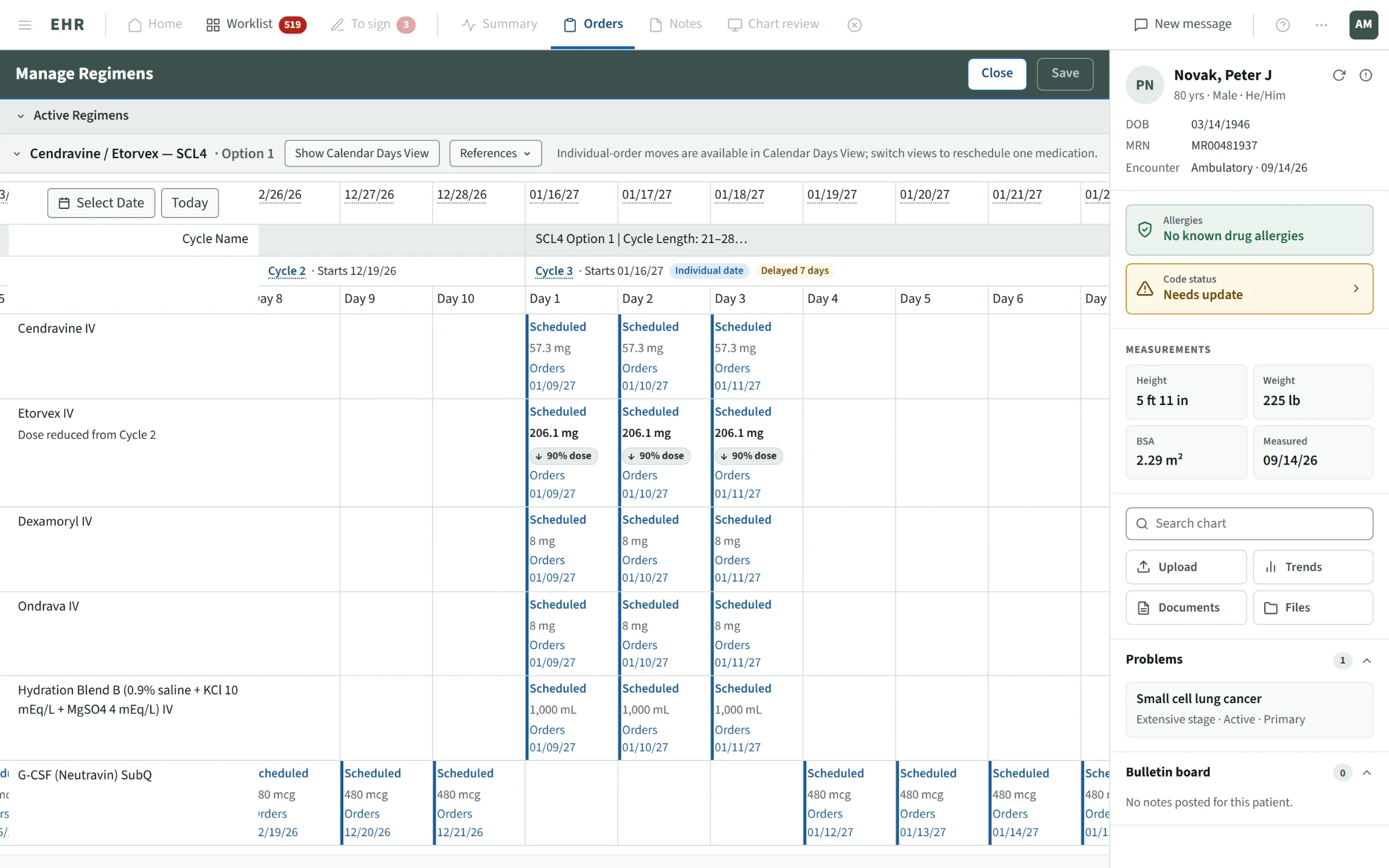
- Moves that match treatment. Move a day, a cycle, or a cycle and everything after it, with day order kept intact and a “Delayed” tag so changes never happen silently.
Iteration
How feedback changed the design
- Site A asked for a 30-day target for monthly infusions, so I added one.
- Site A found choosing affected medications one by one tedious, which led to an “Entire plan” option.
- Site C said blockers must never prevent a date, so provisional dates are allowed while blockers are open.
- Site C preferred a message to schedulers over automatic booking, so “Book first available” sends a task.
- Site C found a moved Day 1 could end up out of order, so I added a re-sequencing rule.
- Site B said orders should be visible as soon as they're signed. That became the core principle.
Status & reflection
Where it stands
The direction was validated with 3 sites and a 6-site survey, and it's in development. There are no outcome numbers yet. To measure success I'd track how often placeholder dates are entered, time from signing to pharmacy verification, and start-date changes made outside the chart.
Still open: what pharmacy may do with an undated plan (view and verify, or dispense), and who confirms the date at each site. Next research: schedulers and authorization coordinators.
- One well-placed question can reframe a whole project.A single question in a Site B review surfaced the 80/20 estimate and the visibility gap.
- Workarounds are requirements in disguise.Every placeholder date and side spreadsheet pointed at something the system wasn't doing.
- Design for disagreement.When sites conflict, make it configurable by role instead of picking a winner.
Contact
If the problem is genuinely hard, I'd like to hear about it.
- Emailbogdan_levchenko@live.com
- LinkedInBogdan Levchenko
- RésuméView résumé